
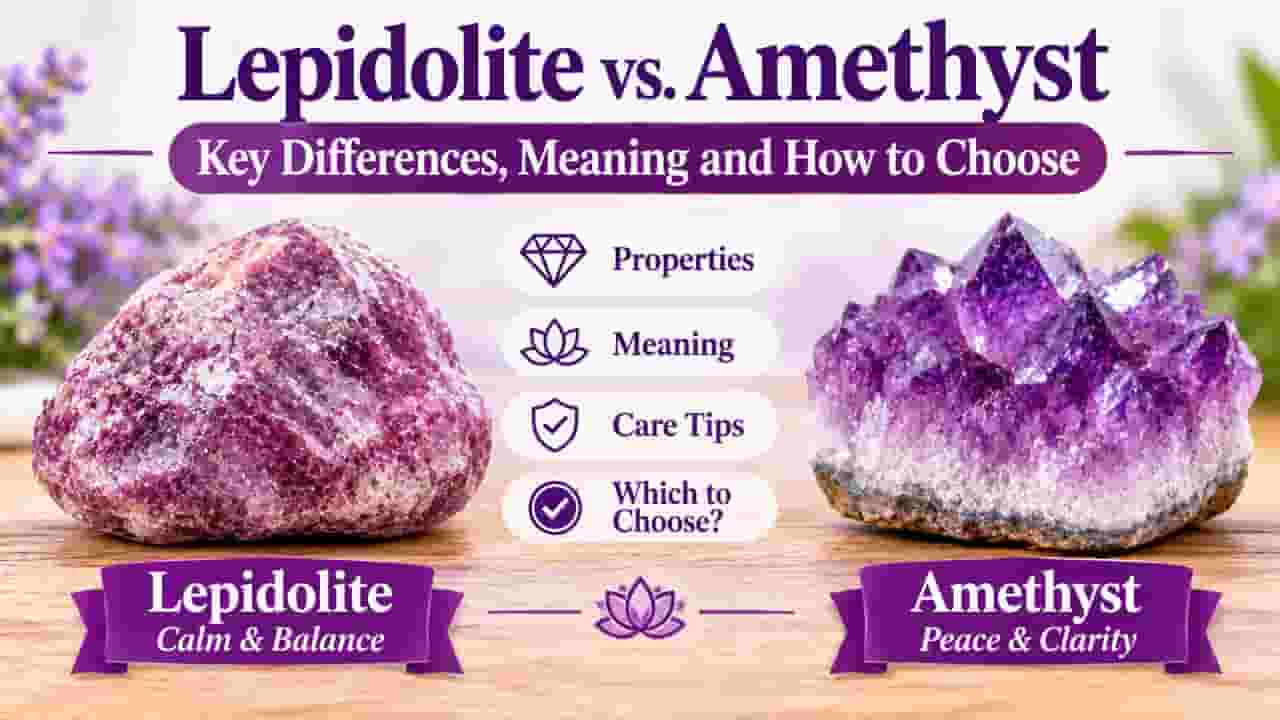
Lepidolite and amethyst are two popular purple crystals, yet they are distinct minerals. Lepidolite belongs to the ‘mica’ group, whereas amethyst is a purple variety of ‘quartz.’ While they may appear similar at first glance, they differ significantly in terms of mineral composition, structure, hardness, and the care they require.
So, which one should you choose? For everyday jewelry, amethyst is generally the better choice, as it is harder and more durable. On the other hand, if you appreciate a soft purple hue and a shimmering, layered texture—or if you are drawn to the traditional beliefs surrounding the stone, such as its association with emotional balance and personal transformation—then you might prefer lepidolite.
This guide compares lepidolite and amethyst, covering their physical properties, traditional meanings, and practical uses, helping you decide which stone best suits your needs.
Lepidolite vs. Amethyst: Quick Comparison
Here is a quick look at the main differences between Lepidolite and Amethyst.
| Feature | Lepidolite | Amethyst |
|---|---|---|
| Mineral group | Mica | Quartz |
| Mineral composition | Lithium-rich mica, commonly containing potassium, lithium, aluminium and silicon | Silicon dioxide |
| Mohs hardness | Approximately 2.5–4 | 7 |
| Common colours | Pink, lilac, lavender and purple | Light lavender to deep purple |
| Appearance | Often flaky, layered or scaly | Usually glassy and crystalline |
| Lustre | Pearly or shimmering | Vitreous (glassy) |
| Cleavage | Perfect in one direction | No distinct cleavage |
| Transparency | Opaque to translucent | Transparent to translucent |
| Durability | Relatively delicate | More resistant to scratching |
| Jewellery suitability | Better in protected settings | Suitable for many types of jewellery |
| Traditional associations | Calmness, emotional balance and personal change | Peace, intuition and spiritual awareness |
Note: Lepidolite’s hardness can vary with its composition. Its softness and perfect cleavage make it more delicate than Amethyst. Mohs hardness measures resistance to scratching, not resistance to breaking.
Table of Contents
What Is the Difference Between Lepidolite and Amethyst?
The primary difference between lepidolite and amethyst lies in their mineral structure. Lepidolite is a mica mineral that naturally forms in thin layers, whereas amethyst is a variety of quartz with a harder, more solid crystal structure.
These differences influence the appearance and texture of the stones, as well as how they are worn and cared for.
Mineral Structure and Composition
Lepidolite and amethyst belong to two distinct mineral groups.
Lepidolite is a lithium-rich mica mineral. It contains potassium, lithium, aluminum, and silicon, along with other elements. Due to its layered structure, it can be separated into thin sheets; this is why lepidolite often has a flaky or layered appearance.
Amethyst is a variety of quartz. Its chemical composition is silicon dioxide—the same as other types of quartz. Its purple color is the result of trace amounts of iron combined with exposure to natural radiation.
Unlike lepidolite, amethyst does not have a sheet-like structure. It typically forms as solid crystals with a glass-like surface.
This structural difference is significant, as it explains why lepidolite is softer and more delicate, while amethyst is considered more suitable for everyday use and jewelry.
Color and Appearance
Both stones can be found in shades of purple, yet their overall appearance is usually quite different.
Lepidolite typically appears in shades of light lavender, lilac (pale purple), pinkish-purple, and violet. Some specimens exhibit a silvery or pearly luster due to the presence of tiny mica layers. You may also observe distinct layers, flakes, or a shimmering effect on its surface.
Read our guide on Can lepidolite stay in the sun? to understand it.
Amethyst can range in color from light lavender to deep purple (violet or dark purple). It generally has a glass-like (vitreous) appearance. Natural amethyst can be found as individual crystals, crystal points, clusters, or rounded pieces.
Relying solely on color is not sufficient to identify these minerals; their texture and crystal structure provide more reliable indicators.
Hardness and Durability
When choosing between these two stones, their hardness is one of the most significant differences.
Amethyst has a Mohs hardness of 7, whereas lepidolite is considerably softer, typically ranging between 2.5 and 4 on the Mohs scale. This means that amethyst is far more resistant to the scratches that can occur during everyday use.
Lepidolite can be scratched by harder minerals, and if handled carelessly, it may break or flake apart. Due to its layered (foliated) structure, it is less suitable for jewelry that is frequently subjected to impact or abrasion.
Amethyst is a better choice for rings, bracelets, and other pieces of jewelry intended for daily wear. However, it is not indestructible; a strong impact can still cause an amethyst crystal to break or develop cracks.
An important point: The ‘Mohs scale’ measures a material’s resistance to scratching. It does not indicate how easily a gemstone might break if dropped.
Cleavage and Texture
‘Cleavage’ refers to the tendency of a mineral to break along specific, flat planes due to its internal structure.
Lepidolite exhibits distinct cleavage in one direction. It can separate into thin layers, which gives it a layered or flaky texture. Because of this property, lepidolite must be handled with great care, especially if its surface is rough or uneven.
Amethyst does not have a layered structure like lepidolite. It typically breaks along curved or uneven surfaces—a characteristic known as a ‘conchoidal fracture.’ Its surface generally appears more solid and glass-like.
If you are comparing two purple stones, this distinction can help you identify them. Lepidolite often appears layered or shimmering, whereas amethyst typically has a glass-like appearance.
Care and Maintenance
Due to its low hardness and distinct cleavage, lepidolite requires more careful handling than amethyst.
How to care for lepidolite:
- Handle it with great care and avoid dropping it.
- Keep it away from harder gemstones that could scratch its surface.
- Avoid using abrasive brushes, rough fabrics, or harsh cleaning products.
- Store it in a soft pouch or a separate, padded container.
- Protect delicate pieces from heavy pressure.
Read our guide on Is It Safe to Put Lepidolite in Water? A Detailed Guide to understand it.
How to care for Amethyst:
- Wipe it with a soft cloth to remove dust.
- For solid gemstones or jewelry, use mild soapy water and wash gently.
- Protect it from harsh chemicals and sudden changes in temperature.
- Avoid leaving it in direct sunlight for long periods, as the color of some Amethyst specimens may fade over time.
Read our guide on Can Amethyst Crystal Go in Water? to understand it.
Store it separately from other jewelry that could scratch or damage its surface. A key distinction is that Lepidolite requires extra protection to prevent scratching, flaking, or physical damage. Amethyst is relatively easy to maintain for everyday use, though it still requires careful handling.
For more detailed storage advice, see our guide on how to store and protect Lepidolite.
Lepidolite vs. Amethyst: Meaning and Spiritual Differences
Beyond their physical characteristics, Lepidolite and Amethyst carry distinct traditional meanings within the realm of crystal-related beliefs.
These meanings stem from spiritual traditions and personal interpretations. They are not scientifically proven effects, nor has it been established that any specific stone can directly bring about particular emotional or mental outcomes.
The Meaning of Lepidolite
Traditionally, Lepidolite is associated with tranquility, emotional balance, and personal transition.
Its soft purple hue and mica-like appearance are often linked to self-reflection and the natural transitions that occur throughout life. Some people choose Lepidolite as a symbol—a reminder to pause, reflect on their experiences, and embrace change with patience.
It is commonly associated with:
- Tranquility and emotional balance
- Personal growth and life transitions
- Self-reflection and self-awareness
- Releasing old habits or patterns
Read our guide on Lepidolite Crystal Benefits: 10 Ways It May Support Calm and Emotional Balance to understand it.
The Meaning of Amethyst
Traditionally, Amethyst is associated with peace, intuition, and spiritual awareness.
It is frequently found in meditation spaces and personal crystal collections. Some people choose it as a symbol of self-reflection, wisdom, and spiritual development.
Its traditional associations include:
- Peace and serenity
- Intuition and spiritual awareness
- Meditation and self-reflection
- Wisdom and personal insight
Read our guide on Amethyst Meaning and Symbolism: What Does Amethyst Represent? to understand it.
What Is the Main Spiritual Difference?
The main difference lies in the symbolism associated with each stone.
Lepidolite is often chosen for its traditional connection to emotional balance and life transitions, whereas Amethyst is primarily associated with intuition, meditation, and spiritual awareness. It is not the case that one stone is better than another or that it offers any proven advantage. Which stone you choose may depend on the personal meaning you associate with it.
Which Is Better: Lepidolite or Amethyst?
None of these stones is definitively better than the other in every respect. The right choice depends on how you intend to use it, the level of care you can provide, and the aesthetic you prefer.
1. Which Is Better for Beginners?
If you are looking for a crystal that is easy to handle and well-suited for everyday jewelry, Amethyst is a great choice. It is relatively hard, making it less prone to scratches during regular use.
Lepidolite is also a good option for those who appreciate its soft purple hue and shimmering texture; however, it requires a bit more care when handling and storing.
2. Which Is Better for Meditation?
Both stones are used in meditation and spiritual practices.
Traditionally, Lepidolite is associated with emotional balance and navigating life transitions, while Amethyst is often linked to intuition, self-reflection, and spiritual awareness.
You can choose the stone whose traditional significance resonates most with your personal meditation practice. There is no scientific evidence to suggest that one stone is more effective than the other for meditation.
3. Which Is Better for Jewellery?
Amethyst is generally the better choice for everyday jewelry, as it is significantly harder than Lepidolite.
It can be used in rings, necklaces, earrings, and bracelets—though it still requires an appropriate setting and standard care.
Lepidolite is much more delicate. It is best suited for jewelry settings where the stone remains protected—such as in pendants or pieces worn only occasionally—where there is little risk of the stone striking or rubbing against hard objects.
If you enjoy wearing Lepidolite jewelry, choose a design that keeps the stone well-protected, and avoid wearing it while performing activities that could cause damage.
4. Which Is Better for Collecting?
This depends on the type of mineral specimens you prefer.
Lepidolite may appeal to those who appreciate mica-group minerals, layered textures, and soft purple or pink hues. Its shimmering surface makes it distinct and visually striking compared to other specimens.
Amethyst, on the other hand, may appeal to those who favor crystal points, clusters, varied color tones, and natural quartz formations.
Both can make excellent and intriguing additions to any mineral collection, each for its own unique reasons.
Can You Wear Lepidolite and Amethyst Together?
Yes, you can wear lepidolite and amethyst together, whether you simply like how they look or subscribe to the traditional beliefs associated with them.
However, there is a practical consideration to keep in mind. Amethyst is significantly harder than lepidolite. If these two stones rub against each other repeatedly—for instance, in a bracelet or other piece of jewelry—the harder amethyst can scratch the softer lepidolite.
To minimize this risk:
- Wear them as separate pieces of jewelry.
- If you are using them together in a single bracelet, ensure there is sufficient space between the beads.
- Use appropriate ‘spacers’ so that the stones do not rub directly against one another.
- Store the stones separately when you are not wearing them.
There are no rigid spiritual rules you must follow when wearing them together; their significance is based on your personal preference and the traditional beliefs associated with these crystals.
How to Choose Between Lepidolite and Amethyst
Your choice should depend on appearance, intended use and durability rather than the idea that one crystal is always better.
| Choose Lepidolite if… | Choose Amethyst if… |
|---|---|
| You prefer soft lavender, lilac or pinkish-purple shades. | You prefer clear, glassy purple crystals. |
| You like shimmering, layered or flaky textures. | You like crystal points, clusters and solid crystal formations. |
| You connect with its traditional symbolism of emotional balance and personal change. | You connect with its traditional associations with intuition and meditation. |
| You enjoy collecting delicate mica specimens. | You want a harder stone for a wider range of jewellery designs. |
| You are comfortable giving a delicate mineral extra care. | You prefer a crystal that is easier to maintain for regular use. |
Before buying either stone, look at its surface, colour and overall condition. If you are purchasing jewellery, also consider the setting and how often you plan to wear it.
A well-chosen stone should suit your personal taste and practical needs.
Read our guide on Lepidolite Crystal Meaning, Properties, Benefits and Uses to understand it.
FAQs About Lepidolite vs. Amethyst
Is Lepidolite the Same as Amethyst?
No. Lepidolite and Amethyst are different minerals. Lepidolite belongs to the mica group, while Amethyst is a purple variety of Quartz. They have different chemical compositions, structures and physical properties.
Which Is Harder, Lepidolite or Amethyst?
Amethyst is harder. It has a Mohs hardness of 7, while Lepidolite is generally around 2.5–4. Amethyst is therefore more resistant to everyday scratches.
Can Lepidolite and Amethyst Be Worn Together?
Yes, but take care when wearing them in the same bracelet or jewellery piece. Amethyst is harder and may scratch Lepidolite if the stones rub against each other repeatedly.
Which Is Better for Everyday Jewellery?
Amethyst is generally better for everyday jewellery because of its greater hardness. Lepidolite is softer and needs a more protective setting and careful handling.
Do Lepidolite and Amethyst Have the Same Meaning?
No. Their traditional spiritual associations are different. Lepidolite is often linked with calmness, emotional balance and personal change, while Amethyst is commonly associated with peace, intuition and spiritual awareness.
How Can You Tell Lepidolite and Amethyst Apart?
Look at their texture and structure rather than colour alone. Lepidolite often has a flaky, layered or pearly appearance, while Amethyst usually looks glassy and crystalline. A mineral identification test may be needed for an uncertain specimen.
Conclusion:- Lepidolite vs. Amethyst
Both lepidolite and amethyst can be purple in color, but they are distinct minerals with different physical properties and traditional meanings.
Amethyst is harder and generally better suited for everyday jewelry. Lepidolite has a flaky, lustrous appearance, but because it is soft, it requires very careful handling.
If durability is your top priority, amethyst is a practical choice. If you appreciate the look of minerals like mica and feel a connection to the traditional symbolism associated with lepidolite, then it might be a better addition to your collection.
Ultimately, choose the stone that you find appealing and that you are able to care for properly. The spiritual meanings attributed to both crystals are based on traditional beliefs and personal perspectives, rather than being guarantees of any specific outcome