

White crystals come in many forms—ranging from transparent ‘clear quartz’ to milky ‘snow quartz,’ silky ‘selenite,’ and patterned ‘howlite.’ Although these stones share a similar color, they differ in appearance, mineral composition, durability, and care requirements.
Many people are drawn to white crystals because they are traditionally associated with peace, clarity, self-reflection, and new beginnings. Others simply appreciate their natural beauty or use them in jewelry and home decor.
In this guide, you will learn about 14 types of white crystals. You will discover how to identify them, what they traditionally symbolize, and how to select and care for them. These meanings are rooted in spiritual and cultural traditions rather than scientifically proven effects.
Table of Contents
White Crystals: Names, Pictures and Meanings
Not all white crystals are made of the same mineral. Some are transparent, others are cloudy or opaque, and some feature streaks, intricate patterns, or a colorful shimmer. By observing these differences, you can understand what makes each stone unique.
Here are 14 such white crystals that are interesting to learn about, along with details regarding their appearance and the common symbolic meanings associated with them.
1. Clear Quartz
Appearance: Clear quartz is typically transparent or semi-transparent and possesses a glass-like luster. Some specimens may contain cloudy areas, internal fractures, or natural inclusions.
Traditional Significance: Clear quartz is frequently associated with clarity, focus, and intention. In certain modern crystal traditions, it is also regarded as an ‘amplifying stone’ (a stone that enhances energy).
Distinctive Features: Its transparency sets it apart from opaque white stones. However, milky-colored clear quartz can sometimes resemble ‘snow quartz.’
Common Uses: Clear quartz is highly popular in crystal collections, jewelry, decorative items, and meditation spaces.
Care: Quartz is quite hard, with a rating of 7 on the Mohs hardness scale. Nevertheless, the way the stone is set and the presence of internal fractures can affect its overall durability. Clean it gently using a soft cloth and mild soapy water (where appropriate).

2. Snow Quartz (Milky Quartz)
Appearance: Snow quartz is a milky-white variety of quartz. It typically appears hazy or opaque because the tiny particles and internal structures within it scatter light.
Traditional Meaning: Snow quartz is commonly associated with patience, simplicity, and a calm approach to daily life.
Distinctive Characteristics: Unlike transparent clear quartz, snow quartz has a soft, hazy appearance. Its color can range from nearly opaque white to slightly translucent.
Common Uses: It is frequently used for polished stones, beads, decorative items, and in personal crystal collections.
Care: Snow quartz has the same hardness as other types of quartz—approximately 7 on the Mohs scale. Avoid knocking it against hard surfaces, and protect any jewelry made from it from unnecessary wear and tear.

3. Selenite
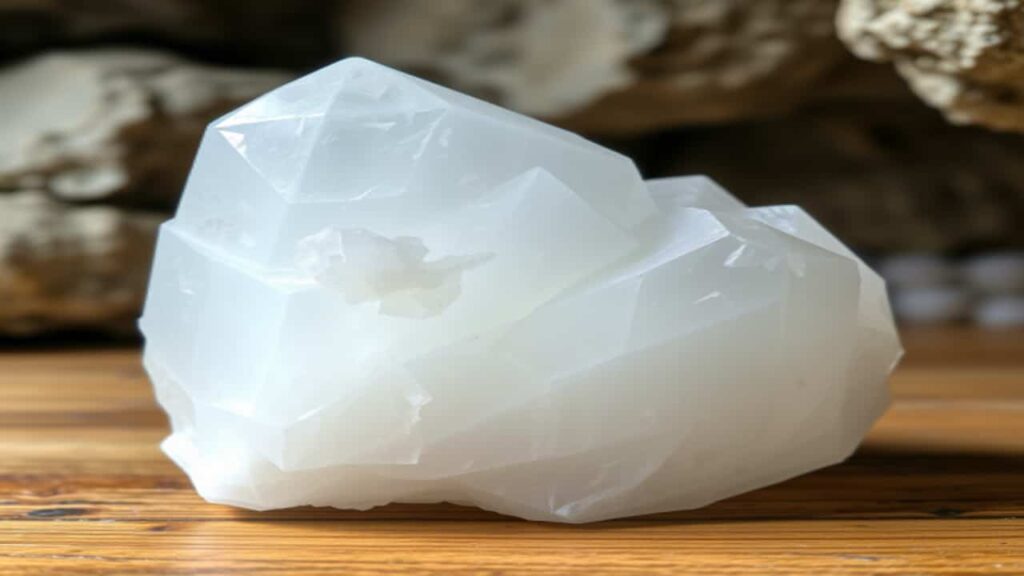
Appearance: Selenite is a form of gypsum that can be colorless, white, or translucent. Depending on the specimen and its structure, it may appear smooth and glass-like, or silky.
Traditional Significance: In modern crystal practices, selenite is often associated with symbolic purification, clarity, and the creation of a peaceful environment.
Distinguishing Features: It is easily recognized by its delicate appearance and soft, sometimes silky, luster. In the crystal trade, the term “selenite” is also frequently used to refer to “satin spar,” another variety of gypsum.
Common Uses: Selenite is popular for creating decorative towers, wands, slabs, and display pieces. Because it is soft, it is less suitable for jewelry that might be subject to frequent impact or abrasion.
Care: Gypsum is a soft material with a Mohs hardness of approximately 2. Avoid soaking selenite in water, as moisture can damage its surface over time. Instead, use a dry, soft cloth for cleaning.
4. Howlite
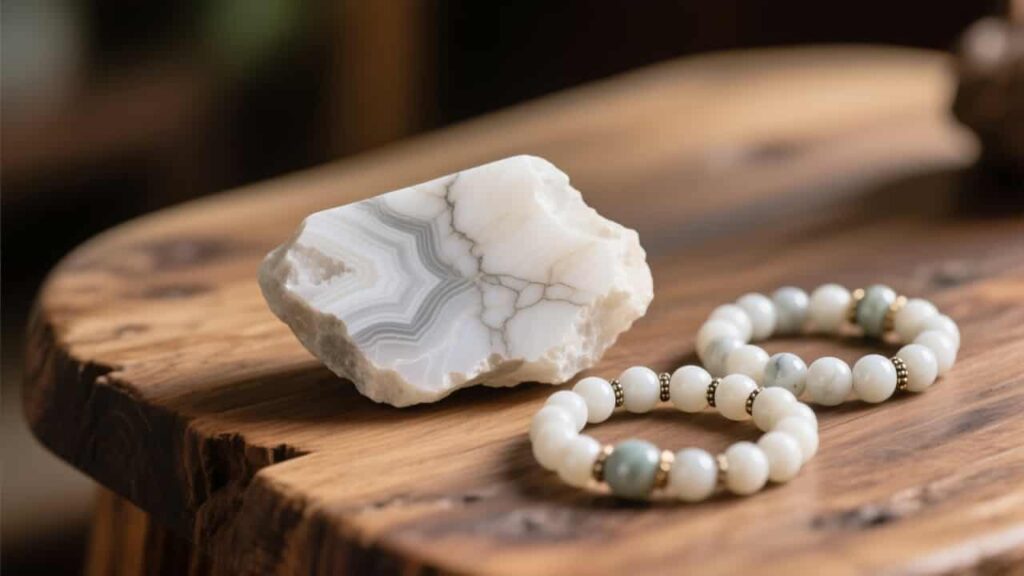
Appearance: Howlite is typically white or off-white in color, featuring thin gray or dark-colored streaks. These streaks often form an irregular, web-like pattern across its surface.
Traditional Significance: In modern crystal traditions, howlite is commonly associated with patience, simplicity, and the capacity for thoughtful reflection.
Distinguishing Features: The gray streaks present in howlite help in identifying it. However, a mineral cannot be definitively identified based on appearance alone; sometimes, stones are dyed to imitate other gemstones.
Common Uses: Howlite is widely used to create beads, bracelets, pendants, and decorative items. It is highly favored for its off-white and gray coloration.
Care: Howlite is a relatively soft stone, with a Mohs hardness of approximately 3.5. Protect it from scratches, harsh chemicals, and sharp impacts. If the stone has been dyed or subjected to any specific treatment, extra care should be taken.
For more detail about this stone, read our guide to White Howlite.
5. White Moonstone
Appearance: White Moonstone is generally white or cream-coloured and may show a soft, floating glow when light moves across its surface. This optical effect is called adularescence.
Traditional meaning: Moonstone is associated in various traditions with reflection, cycles, intuition, and new beginnings.
What makes it distinctive: Its moving sheen is often more noticeable than the stone’s body colour. Not every white Moonstone shows the same degree of glow.
Common uses: White Moonstone is popular in rings, pendants, earrings, and polished gemstone collections.
Care: Moonstone has a Mohs hardness of about 6 to 6.5, but it can be damaged by hard impacts. Store it separately from harder gems and clean it gently with a soft cloth.

6. White Agate
Appearance: White Agate can be white, cream, or a mixture of pale shades. Some specimens have visible bands, while others appear nearly uniform in colour.
Traditional meaning: Agate is often associated with stability, balance, and steadiness in crystal symbolism.
What makes it distinctive: Banded patterns can help distinguish some Agates from other white stones. However, not every specimen has obvious bands, and identification may require closer examination.
Common uses: White Agate is used in beads, bracelets, pendants, cabochons, and decorative objects.
Care: Agate is a form of chalcedony, with a Mohs hardness of about 6.5 to 7. Clean it with a soft cloth or mild soapy water when suitable for the setting. Avoid harsh chemicals that could damage treatments or jewellery components.

7. White Calcite
Appearance: White Calcite may be opaque, cloudy, or translucent. It can have a soft shine and may form chunky crystals, rounded pieces, or larger mineral specimens.
Traditional meaning: In modern crystal practices, Calcite is sometimes associated with fresh perspectives, clarity, and renewed motivation.
What makes it distinctive: Calcite is much softer than Quartz and may have a different crystal shape or surface appearance. White Calcite should not automatically be identified as Quartz just because both stones look pale.
Common uses: White Calcite is often collected as a mineral specimen or used in decorative displays. Its softness makes it less suitable for jewellery exposed to frequent wear.
Care: Calcite has a Mohs hardness of about 3. Avoid abrasive cleaning, acidic cleaners, and rough handling. Acids can react with Calcite and damage its surface.

8. White Jade
Appearance: White Jade generally ranges from creamy white to pale grey-white. It is often opaque or slightly translucent, with a smooth appearance when polished.
Traditional meaning: Jade has a long history of cultural significance in several societies. In different traditions, it is associated with harmony, peace, good fortune, or wise choices.
What makes it distinctive: Jade refers to two minerals, jadeite and nephrite. White material may come from either, and colour alone cannot establish which type you have.
Common uses: White Jade is used in beads, bracelets, pendants, carvings, and decorative objects.
Care: Jade is valued partly for its toughness, but its durability still depends on the specimen and any treatments. Clean it gently and ask a reputable seller about treatments when purchasing an expensive piece.

9. White Opal
Appearance: White Opal has a pale or white body colour. Some specimens show flashes of green, blue, orange, or other colours when viewed from different angles. This effect is known as play-of-colour.
Traditional meaning: Opal is sometimes associated with imagination, creativity, and self-expression in modern crystal symbolism.
What makes it distinctive: The most noticeable feature of precious Opal is its play-of-colour, although not every Opal displays this effect. Some common Opals have a plain appearance without colourful flashes.
Common uses: White Opal is used in rings, pendants, earrings, and gemstone collections. Its appearance can vary considerably from one specimen to another.
Care: Opal is generally softer than many popular jewellery gems and may be sensitive to drying, sudden temperature changes, or impact, depending on the type. Avoid harsh cleaning methods and follow care instructions for the specific Opal.

10. White Topaz
Appearance: White Topaz is colourless and transparent, with a bright, glass-like appearance when cut and polished. It may resemble a diamond to an untrained eye.
Traditional meaning: In modern crystal traditions, Topaz is sometimes linked with clarity, focus, and personal goals. These are symbolic associations rather than proven effects.
What makes it distinctive: White Topaz is a colourless gemstone, not an opaque white stone. Its transparent appearance and faceted cuts make it popular as a diamond alternative.
Common uses: White Topaz is used in rings, earrings, pendants, and other jewellery.
Care: Topaz has a Mohs hardness of 8, but it can split if struck in a vulnerable direction because of its cleavage. Protect it from hard impacts and clean it gently.

11. White Sapphire
Appearance: White Sapphire is a colourless variety of corundum. It is usually transparent and may be cut into a brilliant or other faceted shape to reflect light.
Traditional meaning: Some modern crystal interpretations associate White Sapphire with clarity, wisdom, and focus. Such meanings depend on the tradition and should not be treated as guaranteed outcomes.
What makes it distinctive: White Sapphire can resemble White Topaz or a diamond, but these are different gemstones with different optical and physical properties. A professional gemologist can help distinguish them.
Common uses: White Sapphire is used in rings, earrings, pendants, and other jewellery. Its hardness makes it a practical option for many everyday jewellery designs.
Care: Sapphire has a Mohs hardness of 9. Use gentle cleaning methods and check whether the stone has been treated or whether the setting contains more delicate materials.

12. White Scolecite
Appearance: Scolecite is commonly white or colourless and may form delicate, slender crystals or radiating sprays. Some specimens have a soft, silky or fibrous appearance.
Traditional meaning: In modern crystal practices, Scolecite is often associated with quiet reflection, peaceful surroundings, and meditation.
What makes it distinctive: Its fine, needle-like crystal formations can look very different from the smooth, rounded shapes of polished white stones.
Common uses: Scolecite is mainly collected as a mineral specimen or displayed as part of a crystal collection. Delicate natural formations may be unsuitable for frequent handling.
Care: Scolecite is relatively soft and can be fragile. Keep natural clusters in a secure display area, avoid dropping them, and follow specimen-specific cleaning advice.

13. White Apophyllite
Appearance: Apophyllite can be colourless, white, or pale green. White specimens are often transparent or translucent and may form sharply defined crystals with bright, reflective faces.
Traditional meaning: Apophyllite is sometimes associated with reflection, awareness, and spiritual contemplation in modern crystal traditions.
What makes it distinctive: Its geometric crystal formations and reflective surfaces can help distinguish it from opaque white stones.
Common uses: White Apophyllite is popular among mineral collectors and is often displayed in its natural crystal form.
Care: Apophyllite is relatively soft and may be fragile. Avoid dropping it or using abrasive cleaning tools. Natural clusters should be handled carefully to prevent crystal points from breaking.

14. White Aragonite
Appearance: White Aragonite can form clusters, branching structures, rounded masses, or elongated crystals. Its colour may range from bright white to cream.
Traditional meaning: Aragonite is sometimes associated with grounding, patience, and steadiness in modern crystal symbolism.
What makes it distinctive: Its natural formations can be more important for identification than its colour. Aragonite and Calcite have the same chemical formula but different crystal structures.
Common uses: White Aragonite is often kept as a mineral specimen or used as a decorative piece in a collection.
Care: Aragonite is relatively soft and can be sensitive to acids. Handle it gently, avoid acidic cleaners, and use a dry cloth or a suitable method recommended for the specific specimen.

Quick Comparison of White Crystals
Use this table to compare the stones at a glance. Their traditional associations can help you explore symbolism, while their appearance and durability are more useful for identification and practical selection.
| White crystal | Typical appearance | Traditional association | Practical note |
|---|---|---|---|
| Clear Quartz | Transparent or glassy | Clarity and intention | Relatively hard |
| Snow Quartz | Milky and cloudy | Patience and simplicity | Similar hardness to Clear Quartz |
| Selenite | Translucent or silky | Symbolic cleansing | Soft; avoid soaking |
| Howlite | White with grey veins | Patience and reflection | Can scratch easily |
| White Moonstone | White with a floating sheen | Cycles and reflection | Protect from impacts |
| White Agate | White, cream, sometimes banded | Stability and balance | Suitable for many bead designs |
| White Calcite | Cloudy or translucent | Fresh perspective | Soft and acid-sensitive |
| White Jade | Creamy or grey-white | Harmony and steadiness | Ask about treatments |
| White Opal | White, sometimes with colour flashes | Creativity and imagination | Needs gentle care |
| White Topaz | Transparent and faceted | Focus and clarity | Can split if struck |
| White Sapphire | Transparent and faceted | Wisdom and clarity | Hard and suitable for many jewellery designs |
| White Scolecite | Delicate, slender crystals | Quiet reflection | Natural clusters can be fragile |
| White Apophyllite | Reflective geometric crystals | Awareness and contemplation | Handle natural points carefully |
| White Aragonite | Clusters or branching forms | Patience and grounding | Soft and acid-sensitive |
Mohs hardness measures resistance to scratching, not resistance to breaking. A hard gemstone can still chip or fracture, and a stone’s cut, inclusions, treatments, and setting also affect its durability.
What Do White Crystals Mean?
White crystals hold various meanings across different spiritual practices and cultural traditions. In the context of modern crystal symbolism, the color white is frequently associated with simplicity, clarity, peace, and new beginnings.
These meanings reflect how individuals perceive and utilize crystals. It should be noted that there is no concrete scientific evidence to suggest that the color or presence of a crystal produces specific spiritual or personal outcomes.
- Clarity and Focus
- White or colorless stones, such as clear quartz, are often used as symbols of clear thinking and focused intentions. Some people place them on their desks or in their personal spaces as a reminder to stay focused on their goals.
- Peace and Simplicity
- Milky stones, such as snow quartz and white howlite, are sometimes chosen to represent a simple and peaceful approach to daily life. Their light, neutral tone may also appeal to those who prefer a clean, minimalist aesthetic.
- Self-Reflection and New Beginnings
- White moonstone and other light-colored stones are sometimes associated with self-reflection, transitions, and new beginnings. People may draw upon these symbolic meanings when starting a new project, setting personal intentions, or embarking on a new chapter in life.
- Spiritual Contemplation
- Selenite, scolecite, and apophyllite are frequently incorporated into modern meditation and spiritual practices. Since traditional beliefs surrounding these stones can vary, you may choose them based on your personal preference or the specific symbolism that holds meaning for you.
White Crystals for Different Intentions
If you are choosing a white crystal for a specific purpose, start by considering the symbolism that resonates with you. You do not need an extensive collection or a set of rigid rules to do this.
- White Crystals for Tranquility
- Snow quartz, howlite, and white moonstone are often associated with simplicity, introspection, and the cycles of life. You might place them in a personal space as a gentle reminder that it is sometimes necessary to pause and take time for yourself.
- White Crystals for Clarity and Introspection
- In some contemporary traditions, clear quartz and white sapphire are linked to clarity and focus. For those who appreciate natural crystal points, clear quartz is an excellent choice, while white sapphire is frequently selected as a gemstone for jewelry.
- White Crystals for New Beginnings
- White moonstone and snow quartz are often used to symbolize new beginnings and patience. When you make a new resolution or adopt a new routine, these crystals can serve as a reminder of your goals.
- White Crystals for Meditation
- Selenite, scolecite, and apophyllite are quite popular among those who appreciate the natural forms of crystals and the symbolism associated with them. Choose a crystal that is stable and can be placed securely—especially if it has delicate points.
These suggestions are purely symbolic and are not based on scientific evidence. A stone does not need to carry a specific meaning for you to appreciate its beauty.
White Crystals vs. Clear Crystals: What Is the Difference?
The terms ‘white crystal’ and ‘clear crystal’ do not refer to two distinct groups of minerals, but rather describe their appearance.
White crystals are often milky, opaque, or so lightly colored that you cannot see clearly through them. In contrast, clear crystals are typically transparent, allowing light to pass through them and making objects behind them visible.
For example, ‘clear quartz’ is transparent, whereas other specimens of quartz may appear milky-white. Therefore, a single mineral specimen could potentially fall into either of these categories.
Here is a simple comparison:
| Feature | White crystals | Clear crystals |
|---|---|---|
| Appearance | Often milky, opaque, or cloudy | Usually transparent |
| Examples | Snow Quartz, Howlite, White Calcite | Clear Quartz, White Topaz, White Sapphire |
| Common decorative style | Soft, understated, or patterned | Bright, glass-like, or faceted |
| Identification | Colour and surface patterns may help | Transparency and crystal features may help |
Not every colourless stone is Quartz, and not every white stone is a single mineral type. If you need an accurate identification for a valuable gemstone, consult a qualified gemologist rather than relying on colour alone.
How to Choose a White Crystal
The best white crystal for you depends on whether you are looking for a decorative specimen, a gemstone for jewelry, or a stone with specific traditional significance. These steps can help you narrow down your options.
- Decide How You Will Use It
- For display purposes, you might prefer a natural scolecite cluster or an apophyllite specimen. For a bracelet, consider stones suitable for use as beads or those that can withstand regular wear. For a ring, durability becomes especially important, as rings are frequently exposed to impact.
- Choose the Appearance You Like
- Consider whether you prefer transparent clear quartz, milky snow quartz, patterned howlite, or the ethereal shimmer of white moonstone. Viewing images from various angles can help you compare their visual characteristics.
- Explore the Traditional Meaning
- If symbolism is important to you, research the traditions associated with a stone. You might gravitate toward crystals linked to clarity, reflection, or new beginnings. Rather than viewing these meanings as guaranteed outcomes, consider them in terms of personal or cultural resonance.
- Check Durability and Care
- A soft mineral may be perfectly fine for display, but it might not be suitable for a ring worn frequently. Before purchasing, check the stone’s hardness, durability, any treatments it may have undergone, and the recommended cleaning method.
- Ask Whether the Stone Has Been Treated
- Some gemstones are dyed, coated, filled, or otherwise treated to alter their appearance. Such treatments can affect a stone’s value, durability, and care requirements. Ask the seller to disclose any known treatments, especially when purchasing a high-value gemstone.
- Buy From a Reliable Seller
- Look for a clear description of the gemstone, high-quality photographs, a return policy, and accurate information regarding whether the material is natural, treated, or lab-grown. When purchasing expensive gemstones, a professional gemological report can provide additional assurance.
You do not necessarily need to choose the rarest or most expensive stone. A well-described specimen that aligns with your personal preferences and intended use is often a more practical choice.
How to Cleanse and Care for White Crystals
The correct care method depends on the specific type of mineral, not just its color (such as being white). Water that is safe for one stone might damage another. Furthermore, harsh cleaning methods can compromise any treatments applied to the stones, damage jewelry settings, or harm delicate crystal structures.
- Use gentle cleaning methods
- For many durable stones, it is best to start by cleaning them with a soft cloth. If you are unsure about the identity of a stone, do not submerge it in water until you have learned the specific care requirements for that mineral.
- Keep delicate stones away from rough surfaces
- Minerals like selenite, howlite, and calcite are quite soft; they can be scratched or worn down much more easily than quartz. Keep them separate from harder stones and avoid using abrasive brushes.
- Protect delicate crystal clusters
- Minerals such as scolecite and apophyllite may feature very fine tips or fragile structures. Place them in a stable location where they are unlikely to fall. When handling them, hold them by their sturdier parts rather than their most delicate sections.
- Exercise caution with water and chemicals
- Selenite should never be submerged in water. Calcite and aragonite can react when exposed to acids. Additionally, some stones that have undergone specific treatments may be damaged by solvents or other cleaning products. Do not use steam or ultrasonic cleaners unless an expert has confirmed that they are safe for your specific stone and its setting.
- Store your jewelry properly
- To prevent scratches, store gemstone jewelry in a soft pouch or a separate compartment. Remove your jewelry when engaging in activities where it might be subjected to impact, exposure to chemicals, or excessive wear and tear.
- What about spiritual cleansing?
- Some people use moonlight, intention-setting, or other rituals to symbolically cleanse their crystals. These practices are part of personal or spiritual traditions, rather than scientific methods for altering the properties of the stones. Choose a method that does not cause any physical damage to the stone.

FAQs About White Crystals
What are the most popular white crystals?
Clear Quartz, Snow Quartz, Selenite, Howlite, White Moonstone, White Agate, and White Calcite are among the white stones commonly found in crystal shops and collections. Their availability varies by location and seller.
What do white crystals symbolize?
In modern crystal traditions, white crystals are often associated with clarity, peace, simplicity, reflection, and new beginnings. Meanings vary between traditions and are not scientifically proven effects.
Are white and clear crystals the same?
No. White crystals often look milky or opaque, while clear crystals are transparent. However, some minerals, including Quartz, can occur in both white and clear forms.
Which white crystals are best for beginners?
Clear Quartz, Snow Quartz, and Howlite are useful starting points because their appearances are easy to compare and they are widely available. If you want a crystal for regular jewellery use, choose based on durability as well as appearance.
Can white crystals go in water?
Not all white crystals are suitable for water. Selenite is soft and moisture-sensitive, while Calcite and Aragonite can be damaged by acids. Check the identity and care instructions for each stone before washing it.
Is Selenite the same as Satin Spar?
They are both forms of gypsum, but they have different crystal structures and appearances. In the crystal trade, the name “Selenite” is often used broadly for Satin Spar products, so the label may not always identify the exact material.
Can white crystals be worn as jewellery?
Yes, many white gemstones are used in jewellery. White Sapphire and Clear Quartz can suit various jewellery designs, while softer stones such as Howlite and Selenite need more careful handling. The best choice depends on the stone, its setting, and how often you plan to wear it.
Conclusion:- White Crystals
White crystals offer a wide range of appearances, from transparent gemstones to milky stones and delicate natural clusters. Clear Quartz, Snow Quartz, Selenite, Howlite, White Moonstone, and the other stones in this guide each have distinct features worth exploring.
If traditional meanings are important to you, use them as a way to express personal intentions rather than as promises of a particular result. If you are buying a crystal for jewellery or collecting, pay close attention to its identity, durability, treatments, and care needs.
The right white crystal is one that you enjoy, understand, and can look after properly.
If you wish to deepen your spiritual journey and discover how different gems can balance your mind, body, and spirit, be sure to explore our complete Crystal Stones Meanings, Uses, Power & Pictures Guide. This master resource covers everything from identifying raw minerals to unlocking their unique vibrational energies, complete with high-resolution visual references to help you choose the right crystal for your needs.