
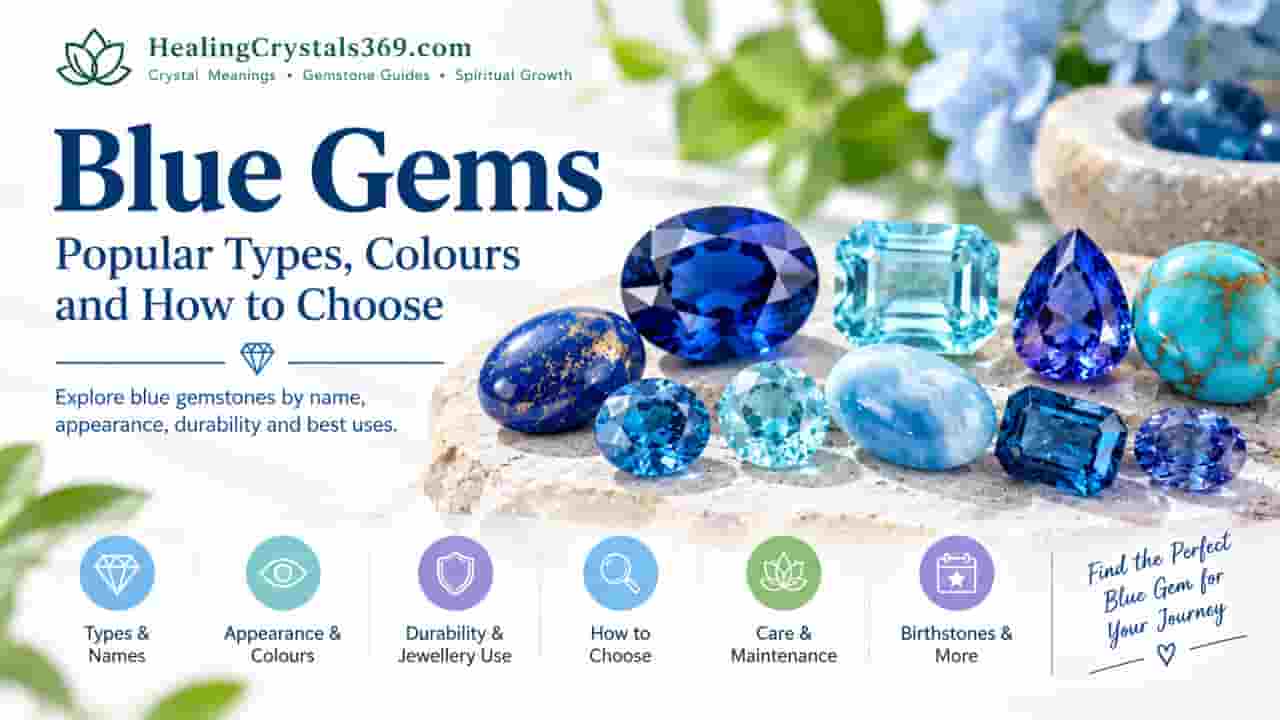
Blue gems come in a variety of shades—ranging from light sky blue to deep royal blue, and even blue-green. Popular examples include blue sapphire, aquamarine, blue topaz, tanzanite, turquoise, and lapis lazuli. Although these gemstones share a blue hue, they differ in their mineral composition, appearance, durability, availability, and price.
Some blue gemstones are transparent and sparkle when cut, while others are opaque, featuring solid colors or natural patterns. Whether you are looking for a blue gemstone for a ring, pendant, or pair of earrings—or perhaps for your personal collection or as a birthstone gift—understanding these differences will help you choose the perfect one.
Table of Contents
Types of Blue Gems: Names and Pictures
Not all blue gemstones are the same. Some are so clear that you can see right through them, while others appear solid or patterned. The guide below compares popular blue gemstones based on their color, appearance, distinctive features, and common uses.
Popular Blue Gemstones
1. Blue Sapphire
Blue Sapphire is a well-known precious gemstone, prized for its deep blue color and durability. Its hue can range from light blue to a deep, vivid ‘royal blue.’ Some sapphires may also exhibit subtle violet or greenish undertones.
Sapphires are typically transparent or semi-transparent and are frequently cut into various shapes, such as oval, round, or cushion. The color and clarity can vary from one stone to another.

What sets it apart? On the ‘Mohs hardness scale,’ the sapphire receives a rating of 9, making it one of the hardest gemstones used in jewelry. This makes it an excellent choice for engagement rings and other pieces intended for daily wear. However, factors such as internal inclusions, any treatments the stone may have undergone, and the method used to set it are also highly significant.
Common uses: Engagement rings, everyday rings, pendants, earrings, and other fine jewelry.
Comparison: While ‘blue spinel’ can also feature a deep blue color, the sapphire is significantly harder. It is not possible to definitively identify a gemstone based solely on its color.
2. Aquamarine
Aquamarine is a variety of the mineral beryl, ranging in color from blue to blue-green. Its hue is typically light and clear, though some stones can exhibit a deeper blue shade.
Most aquamarine used in jewelry is transparent and faceted. Its clean, clear appearance is highly favored by those who prefer a light blue tone over more intense, darker colors.

How does it differ from other gems? Aquamarine belongs to the same mineral family as emerald, yet it differs in both color and overall appearance. On the Mohs scale, it has a hardness ranging from 7.5 to 8.
Common uses: Pendants, earrings, necklaces, and rings. With proper care and a secure setting, it is suitable for everyday jewelry.
Comparisons: Sky-blue topaz can look quite similar to aquamarine. Since they are distinct minerals, it can be difficult to distinguish between the two based solely on their color.
3. Blue Topaz
Blue topaz is a transparent gemstone available in various shades. ‘Sky blue’ is light and bright, ‘Swiss blue’ is more vivid, and ‘London blue’ is typically deep and intense. These names and their corresponding colors may vary depending on the seller.
When well-cut, the surface of a blue topaz is often clear and lustrous. It is widely used in jewelry and is available in a variety of shapes.

What are its characteristics? Topaz has a hardness of 8 on the Mohs scale; however, it possesses cleavage, meaning that a strong impact can cause it to break or sustain damage in certain directions. Hardness alone does not protect a gemstone from every type of damage.
An important point to note when purchasing is that most blue topaz found on the market has been treated to achieve its color—typically through a process involving irradiation followed by heating. Ask the seller about treatment disclosure. [Gemological Institute of America: Topaz](https://www.gia.edu/ gia-website/topaz)
Common uses: Fashion rings, pendants, earrings, and other jewelry.
Comparison: Aquamarine typically features a light blue color that appears more natural, whereas blue topaz is available in a variety of deeper blue shades. It is not possible to definitively identify a gemstone simply by looking at it.
4. Tanzanite
Tanzanite is known for its blue to violet-blue color. Depending on the specific stone and the viewing angle, the shades of color may appear slightly different.
It is typically transparent and is frequently cut and faceted into a gemstone. Its distinctive blue-violet hue makes it highly popular for fine jewelry.
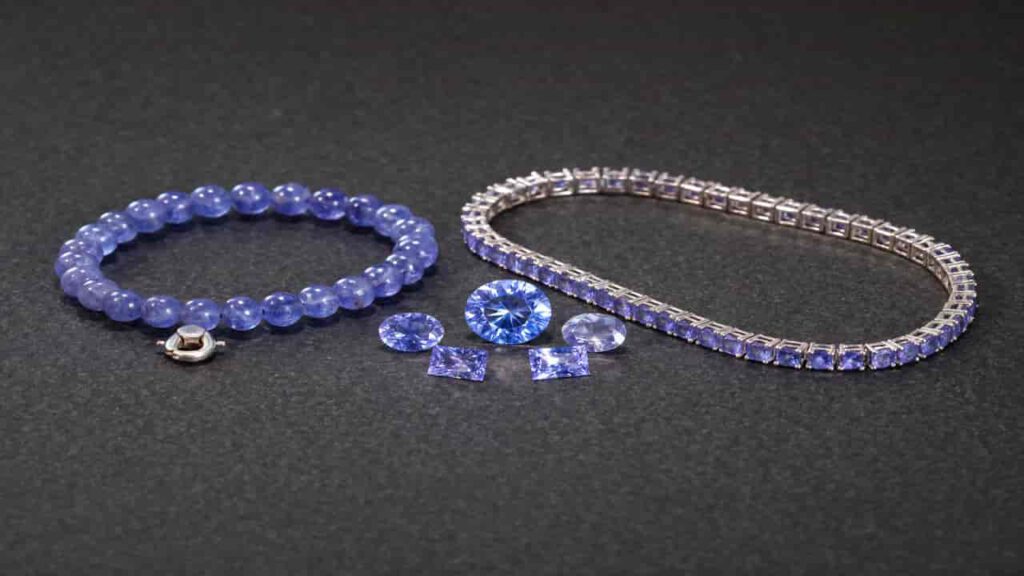
How does it differ from other gemstones? Tanzanite has a hardness of 6–7 on the Mohs scale and exhibits ‘cleavage’ (a tendency to break along specific planes); therefore, it requires greater protection from sharp impacts compared to sapphire or spinel. It is better suited for jewelry intended for careful wear rather than for pieces subjected to the rigors of daily, rough use.
Common uses: Pendants, earrings, jewelry for special occasions, and rings that are worn with great care.
Comparison: Sapphire is harder and generally more suitable for rings intended for frequent, everyday wear. Tanzanite is often chosen specifically for its unique blue-violet color.
5. Blue Zircon
Blue zircon is a natural gemstone known for its intense brilliance and excellent light-reflecting properties. It can range in color from light blue to deep blue, and many specimens are transparent.
Blue zircon is distinct from cubic zirconia. Cubic zirconia is a different material often used as a diamond simulant (imitation diamond), whereas zircon is a natural mineral that can be cut and faceted as a gemstone.

How does it differ? While blue zircon can be highly brilliant, its level of hardness makes it more susceptible to wear, tear, or scratching. Many blue zircon stones undergo ‘heat treatment’ to achieve their specific color.
Common uses: Earrings, pendants, and rings—provided they are handled with proper care.
Comparison: Blue topaz can also be brilliant and transparent. A trained gemologist can distinguish between these stones by examining their physical and optical properties.
6. Blue Spinel
Blue spinel is a transparent gemstone that can range in color from light blue to a deep, vivid blue. Some specimens may even resemble sapphire.
It is highly valued for its color, clarity, and suitability for jewelry. While some blue spinels exhibit a deep, uniform color, others may appear lighter or paler.

What sets it apart? With a hardness of 8 on the Mohs scale, spinel is considered a durable gemstone. Given the right stone and an appropriate setting, it makes an excellent choice for rings and other pieces of jewelry intended for daily wear.
Common uses: Rings, pendants, earrings, and other fine jewelry.
Comparison: Sapphire is harder, but both are attractive options for blue-toned jewelry. The price of a blue spinel depends on factors such as its color, quality, size, origin, and whether the stone has undergone any form of treatment.
7. Blue Tourmaline
Blue tourmaline, sometimes sold as ‘indicolite,’ can range in color from light blue to deep blue or blue-green. Some stones may also exhibit a slight greenish tint.
Transparent blue tourmaline is typically faceted. Its color and clarity can vary, and some stones may contain internal inclusions.
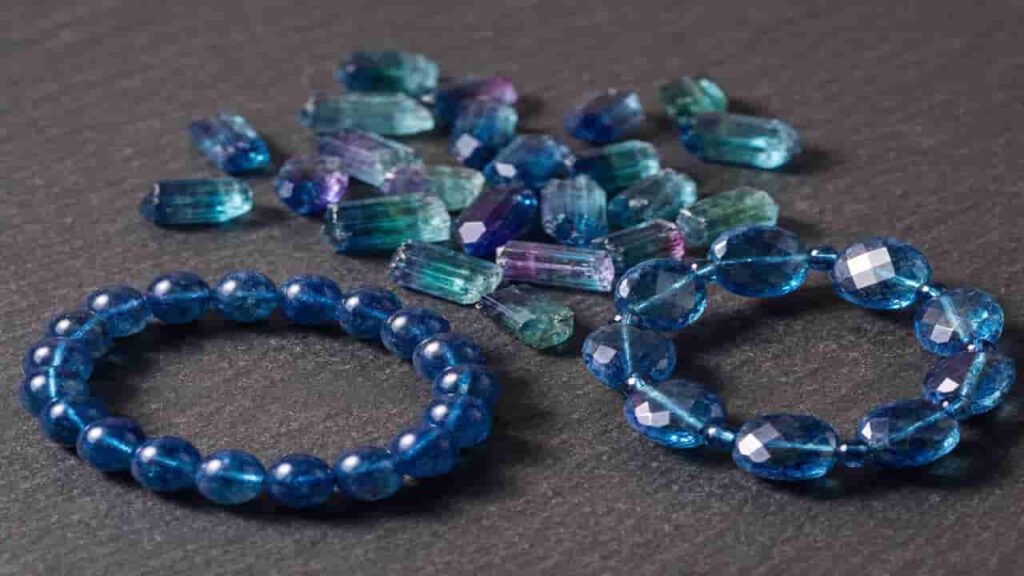
How does it differ from others? Tourmaline is a group of minerals that encompasses a wide variety of colors. Compared to other popular blue gemstones on the market, blue tourmaline is relatively rare, and its price can vary significantly.
Common uses: Pendants, earrings, and rings. It can be used in everyday jewelry, though it is important to consider the condition of the stone and its setting before doing so.
Comparisons: Aquamarine can also have a blue-green hue, similar to blue tourmaline. Since tourmaline and aquamarine belong to different mineral groups, it may be necessary to consult a gemologist to definitively distinguish between them.
8. Iolite
Iolite typically ranges in color from blue to violet-blue, and its appearance can shift slightly depending on the viewing angle. As a result, the color of the stone may seem to change as it moves.
It is generally transparent to translucent and is frequently cut into faceted gemstones.

What makes it unique? Iolite is known for its directional color effect, a phenomenon called pleochroism. It has a hardness of approximately 7–7.5 on the Mohs scale; however, due to the presence of internal fractures (cleavage planes), it requires protection from hard impacts.
Common uses: Pendants, earrings, and rings (worn with care).
Comparison: Sapphire and tanzanite can also appear blue or violet-blue. Iolite, however, tends to exhibit a more pronounced change in color depending on the angle from which it is viewed.
Blue Gems with Opaque or Patterned Appearance
These gemstones look different from transparent, faceted blue gems. Many are cut and polished into smooth shapes called cabochons, or used as beads and decorative pieces.
9. Turquoise
Turquoise is typically opaque, with a color ranging from blue to blue-green. Some stones feature brown, black, or other matrix patterns, while others have a more uniform color.
What are its characteristics? Unlike sapphire or topaz, turquoise is not transparent or glass-like; it has a solid, opaque texture. It has a hardness of approximately 5–6 on the Mohs scale, and some stones undergo treatments to enhance their beauty.
Common uses: Beads, pendants, cabochon-cut rings, bracelets, and decorative jewelry.
Care instructions: Turquoise can be affected by chemicals, cosmetics, skin oils, and certain cleaning methods. Before choosing a cleaning or care method, check whether the stone has been treated.
10. Lapis Lazuli
Lapis lazuli is an opaque, deep-blue gemstone. It may contain small flecks of gold-colored pyrite or patches of white calcite. These natural characteristics give each piece a unique appearance.
How does it differ from other gems? Unlike stones such as sapphire or blue topaz, lapis lazuli lacks a transparent luster. Its deep color and natural patterns are its defining features.
On the Mohs scale, its hardness typically ranges from 5 to 6 (depending on its specific composition), making it more susceptible to scratches compared to harder gemstones.
Common uses: Beads, pendants, cabochons (rounded, polished gems), inlays, and decorative objects.
Care tips: Avoid harsh chemicals and abrasive cleaning materials. Some lapis lazuli may be dyed, waxed, or otherwise treated; therefore, be sure to inquire about any such treatments before making a purchase.
11. Blue Chalcedony
Blue chalcedony is a variety of microcrystalline quartz. It typically ranges from translucent to opaque and often features a soft, uniform blue color. Some specimens appear pale and hazy, while others exhibit a deeper, more intense hue.
How does it differ from other stones? Unlike transparent, faceted gemstones, blue chalcedony possesses a softer, more gentle appearance. It can be polished into ‘cabochons’ (rounded or oval shapes) or fashioned into beads.
Common uses: Pendants, earrings, beads, and everyday decorative jewelry.
Comparison: Aquamarine is generally more transparent and belongs to a different mineral group. Blue chalcedony typically has a softer look and appears less glass-like.
12. Larimar
Larimar is a blue variety of the mineral pectolite, known for its blue and white patterns. Its appearance can evoke the look of shallow tropical waters, featuring markings that resemble clouds or waves.
It typically ranges from opaque to translucent. Rather than being faceted like traditional transparent gemstones, it is usually polished.
What makes it unique? Its distinctive blue-and-white pattern is its most defining characteristic; no two pieces share the exact same pattern or shade.
Common uses: It is used to create pendants, earrings, beads, and statement jewelry.
Care tips: Larimar is softer than many other common gemstones, so it should be protected from scratches and hard impacts.
13. Dumortierite
Dumortierite is a mineral found in various shades of blue; it sometimes occurs as a solid material suitable for use as an ornamental stone. Its color can range from light to dark blue, and it typically appears opaque or uneven in texture.
What makes it special? Compared to gemstones like sapphire, aquamarine, or topaz, dumortierite is less common in mainstream jewelry. It holds greater appeal for collectors and enthusiasts of unusual blue minerals.
Typical uses: Polished stones, beads, cabochons, and mineral collections.
Comparison: Some blue dumortierite specimens may resemble sodalite or other opaque blue stones. Identification should not be based on color alone.
Light Blue and Sky-Blue Gems
If you prefer a pale blue colour, start by comparing these options. Their appearance can overlap, so look at transparency, sparkle, patterns, and the stone’s documented identity.
Aquamarine
Aquamarine is typically clear and light blue or blue-green in color. It is a suitable choice for those who prefer subtle, understated gemstones.
Light Blue Sapphire
A light blue sapphire is a genuine sapphire that is lighter in shade than the deep blue color many people typically associate with the gem. It retains the high hardness characteristic of sapphires, making it durable enough for jewelry intended for regular wear.
Sky-Blue Topaz
Sky-blue topaz features a bright, light blue hue and is widely used in jewelry. Most blue topaz available on the market has been treated to achieve its color, so be sure to ask about any treatments before making a purchase.
Blue Chalcedony
Blue chalcedony is an excellent option if you are looking for a soft blue stone with a hazy or translucent appearance, rather than the brilliance of a clear, faceted gemstone.
Quick comparison: In photographs, aquamarine and sky-blue topaz can look identical. A light-blue sapphire might also appear similar. While you can compare their visual appearance through a photograph, it is not possible to definitively identify a gemstone or determine its treatment history from an image alone.
Dark Blue and Royal Blue Gems
Deep blue gemstones can be quite attractive, but they differ in terms of transparency, patterns, and durability.
Royal Blue Sapphire
Royal Blue Sapphire is known for its deep, vivid blue color. The term refers to a specific shade rather than a distinct mineral. Due to its hardness, sapphire is a popular choice for rings and fine jewelry.
Lapis Lazuli
Lapis Lazuli is opaque and deep blue in color. It may contain golden-colored pyrite flecks or white calcite inclusions. It is prized not for transparency or brilliance, but for its solid color and natural patterns.
Dark Blue Spinel
Dark Blue Spinel features a deep blue hue and appears clear, much like a faceted gemstone. Spinel is generally durable and can be used in a variety of jewelry pieces.
Iolite
Iolite can appear deep blue or violet-blue. Its color may shift depending on the viewing angle—a characteristic that distinguishes it from stones that maintain a consistent color from every perspective.
Remember: A deep color does not necessarily mean that a gemstone is rare or more valuable. Factors such as color quality, clarity, size, any treatments applied, origin, and demand all influence its value.
Blue Gemstones Comparison Table
Use this table to compare the appearance, hardness, and common uses of selected blue gems. Mohs hardness measures resistance to scratching, not overall toughness. A hard gemstone can still chip or break if struck in the wrong place.
| Blue gem | Typical appearance | Approximate Mohs hardness | Common uses |
|---|---|---|---|
| Blue sapphire | Transparent to translucent, often rich blue | 9 | Rings, pendants, fine jewellery |
| Aquamarine | Clear, pale blue to blue-green | 7.5–8 | Rings, pendants, earrings |
| Blue topaz | Transparent, light to deep blue | 8 | Rings, earrings, fashion jewellery |
| Tanzanite | Transparent, blue to violet-blue | 6–7 | Pendants, earrings, carefully worn rings |
| Blue spinel | Transparent, pale to deep blue | 8 | Rings, pendants, earrings |
| Blue zircon | Transparent, bright blue | About 6–7.5 | Earrings, pendants, carefully worn rings |
| Blue tourmaline | Transparent, blue to blue-green | About 7–7.5 | Rings, pendants, earrings |
| Iolite | Transparent to translucent, blue-violet | About 7–7.5 | Pendants, earrings, selected rings |
| Turquoise | Usually opaque, blue to blue-green | About 5–6 | Beads, cabochons, pendants |
| Lapis lazuli | Opaque, deep blue, sometimes patterned | About 5–6 | Beads, pendants, decorative pieces |
| Blue chalcedony | Translucent to opaque, soft blue | About 6.5–7 | Beads, cabochons, pendants |
| Larimar | Usually opaque to translucent, blue and white patterns | Varies by material; generally softer than many faceted gems | Pendants, beads, statement jewellery |
| Dumortierite | Usually opaque, blue to dark blue | Varies by material; often around 7–8 | Polished stones, beads, collections |
Hardness values are approximate. The exact value and durability of a particular stone can depend on its composition, inclusions, treatments, and condition. For purchase decisions, check a reputable gemological reference for the specific material.
Light Blue vs. Dark Blue Gemstones
The best shade of blue depends entirely on your personal preference. Some people prefer light, airy tones, while others favor deep, bold blues that truly stand out.
Light blue: Aquamarine, sky-blue topaz, and light-blue sapphire are common choices. Blue chalcedony offers a softer, more subtle appearance with less brilliance.
- Deep or vivid blue: Certain sapphires and blue spinels exhibit very deep, intense, and vivid hues.
- Blue-violet: Tanzanite and iolite can display hints of violet or purple alongside their blue tones.
- Blue-green: Some aquamarines and blue tourmalines show a distinct greenish undertone.
- Opaque blue: Stones like turquoise and lapis lazuli do not have a translucent sparkle; instead, they feature solid colors or natural patterns.
When comparing gemstones, examine them under good lighting—ideally, observe them in various lighting conditions or settings. Keep in mind that a gemstone might appear brighter, deeper, or more vivid in photographs than it does in person.
No single shade is inherently the “best” or most valuable. A light-colored stone can be just as captivating as a deep-blue one; the value of a gemstone depends on its specific type and individual quality.
Best Blue Gems for Jewellery
The best gemstone for jewelry depends on where you plan to wear it. Rings are generally subjected to more knocks and abrasion than pendants or earrings, so durability is key.
Blue Gemstones for Everyday Rings
Blue sapphire and blue spinel are excellent choices, as they possess good hardness and, typically, high durability. When well-cut and securely set, both are suitable for rings intended for daily wear.
Aquamarine and blue topaz can also be used in everyday rings, but they require careful handling. Topaz, for instance, has cleavage planes; despite its hardness, a sharp impact can cause it to fracture or break.
Tanzanite, turquoise, and lapis lazuli generally require extra protection against knocks, scratches, or improper cleaning. These are better suited for jewelry worn with care, or for designs that provide physical protection to the gemstone.
Before choosing a ring, inquire about both its hardness and toughness. Additionally, consider the setting, the shape of any exposed corners, and whether the gemstone contains any fractures or has undergone any treatments.
Blue Gemstones for Pendants and Earrings
Pendants and earrings are generally less exposed to direct impact than rings, making them suitable settings for certain gemstones that require extra care.
Depending on the design, aquamarine, tanzanite, blue topaz, blue zircon, and blue chalcedony can be attractive choices. Turquoise and lapis lazuli are also popular options for opaque or patterned pendants and earrings.
Even when worn as earrings or pendants, gemstones should be protected from hard knocks, chemicals, and unsuitable cleaning products. Remove your jewelry when engaging in activities that could potentially damage it.
Affordable Blue Gemstone Options
Blue topaz is readily available in a variety of shades and is often sold at affordable prices. Certain blue spinels, smaller aquamarines, and blue chalcedony can also be found within a modest budget.
However, no gemstone is inherently cheap or expensive. Its price can vary based on factors such as color, clarity, size, cut, origin, any treatments it has undergone, and current market demand. A large, high-quality gemstone can command a significantly higher price than a smaller stone of similar quality.
When comparing prices, ensure you are looking at gemstones of similar size and quality, and check whether information regarding any treatments has been provided.
How to Choose a Blue Gemstone
You don’t need to know every single detail about a blue gemstone before making a purchase. Follow these five steps to narrow down your options.
- Choose the color and appearance. Decide whether you prefer light blue, deep royal blue, blue-violet, blue-green, or an opaque stone with natural patterns.
- Consider how you intend to use it. A stone for an everyday ring requires a different level of durability compared to one intended for an occasional-wear pendant or a piece kept in a collection.
- Learn about durability and care. Inquire about the stone’s hardness, toughness, cleavage, inclusions, and any specific care requirements. These factors determine how the gemstone should be worn.
- Ask whether the stone is natural, treated, lab-grown, or an imitation. These are distinct categories. A treated natural gemstone is still a natural stone; its appearance has simply been altered.
- Compare quality and seller information. Check the stone’s dimensions, weight, details regarding any treatments, the return policy, and whether a gemological report is available.
Do not judge a gemstone’s authenticity or value based solely on its color. Glass, synthetic materials, and various types of natural gemstones can look identical. If you are purchasing an expensive gemstone, ensure you obtain an independent gemological report from a reputable laboratory.
Natural vs. Treated vs. Lab-Grown Blue Gems
The color of a blue gemstone does not indicate how it was formed or whether its appearance has been altered. These two concepts refer to different things.
1. Natural Gemstones
Natural gemstones are formed through geological processes. They may be cut and polished before being sold, and some may undergo treatments to enhance their color or clarity.
Being “natural” does not necessarily mean that a gemstone is untreated, rare, or highly valuable; these are separate considerations.
2. Treated Gemstones
A treated gemstone is one whose appearance or properties have been intentionally altered. Depending on the type of gemstone, such treatments may include heating, irradiation, dyeing, coating, or other processes.
Blue topaz is a common example of this: most blue topaz sold today has been treated to achieve its blue color. Sapphires can also be treated. Buyers should ask whether a gemstone has undergone any form of treatment, and whether this affects its care requirements or its value. GIA’s guide to gem treatments explains why treatment information matters.
3. Laboratory-Grown Gemstones
Laboratory-grown gemstones are created in a controlled environment. Their chemical and crystal structures can be identical to those of natural gemstones, although the process by which they are formed differs.
For example, a laboratory-grown sapphire is entirely different from an imitation made of blue glass. Its identity must be clearly disclosed at the time of sale.
4. Imitation Gemstones
An imitation gemstone is a material that resembles a specific gemstone but possesses a different composition or structure. Glass and various other synthetic materials can be used to create imitations of blue gemstones.
While imitation gemstones can be attractive and suitable for fashion jewelry, they should not be sold as the genuine gemstones they are intended to mimic.
Buying Tips: Ask the seller about the identity of the gemstone, and obtain written confirmation regarding whether it has undergone any specific treatments or if it is laboratory-grown. For valuable gemstones, a report from an independent organization can provide greater assurance. It is impossible to determine whether a gemstone has been treated or is laboratory-grown simply by looking at it.
Blue Gemstones and Birthstones
Some blue gemstones are considered modern ‘birthstones.’ This depends on the specific gemstone and the particular birthstone list you are referring to; not every blue gemstone is a birthstone.
- September — Sapphire: Blue sapphire is a very well-known birthstone for September.
- March — Aquamarine: Aquamarine is a very well-known birthstone for March.
- December — Blue Topaz: In many modern birthstone lists for December, ‘blue topaz’ is included alongside other options.
Birthstone lists can vary according to different traditions and organizations, and for some months, more than one gemstone may be recognized. If you are purchasing a birthday gift, it is a good idea to find out which birthstone tradition the recipient follows.
How to Care for Blue Gemstones
There is no single cleaning method that is safe for all blue gemstones. The appropriate cleaning method depends on the gemstone’s hardness, durability, susceptibility to fractures, any treatments it may have undergone, and the presence of any internal impurities.
- Sapphire and Blue Spinel: These are generally durable gemstones; however, check their settings and avoid subjecting them to hard impacts. Use a cleaning method recommended for the specific gemstone and any treatments applied to it.
- Tanzanite: Protect it from hard impacts and sudden changes in temperature. Do not use steam or ultrasonic cleaners.
- Turquoise: Keep it away from cosmetics, chemicals, and excessive heat. Some turquoise is treated, which may influence the appropriate cleaning method.
- Lapis Lazuli: Avoid abrasive cleaning methods and harsh chemicals. Some stones may contain dyes, wax, or other treatments that could be affected by solvents.
- Blue Topaz: Despite its hardness, topaz is prone to fractures. Protect it from hard impacts and avoid cleaning methods that could place the stone under stress or cause damage.
- Blue Zircon: Handle with care to prevent scratching or breakage, and verify whether the stone has undergone any treatments.
For many gemstones, cleaning gently with a soft cloth may be appropriate; however, do not assume that a single method works for every stone. If in doubt, consult a qualified jeweler or gemologist regarding the proper care for that specific gemstone.
For additional guidance, see the International Gem Society’s gemstone care guide.
FAQs About Blue Gems
What are the most popular blue gems?
Blue sapphire, aquamarine, blue topaz, tanzanite, turquoise, and lapis lazuli are well-known examples. They differ in transparency, colour, durability, and common uses.
What is the most valuable blue gemstone?
There is no single answer for every stone. High-quality blue sapphires can command very high prices, but value depends on factors such as colour, clarity, size, origin, treatment, rarity, and demand. Other blue gems can also be valuable when their quality and market demand justify it.
Which blue gemstones are best for everyday wear?
Blue sapphire and blue spinel are strong options to consider for frequently worn rings because they are hard and generally durable. The setting and condition of the individual stone still matter.
Which blue gems are light blue?
Aquamarine, sky blue topaz, light blue sapphire, and blue chalcedony are common choices. Aquamarine and topaz can look similar, so do not rely on colour alone to identify them.
Which blue gemstones are dark blue?
Some sapphires and blue spinels have deep blue colours. Lapis lazuli is another dark blue option, but it is opaque and often has a different texture and appearance from transparent faceted gems.
Are blue gemstones naturally blue?
Some blue gemstones occur naturally in blue shades, but treatments are also common. Most blue topaz on the market has been treated to produce its colour, and some other blue gems may also be treated. Ask the seller about treatment status.
What is the difference between blue gems and blue crystals?
The terms can overlap. A gemstone is a material valued for use in jewellery or decoration, while a crystal describes an ordered internal structure or a naturally formed crystal shape. Some materials can be described as both gemstones and crystals. The best term depends on the material and the context.
Which blue gemstones are birthstones?
Sapphire is a widely recognised September birthstone, aquamarine is associated with March, and blue topaz is included in many modern lists for December. Birthstone traditions vary, and some months have alternative stones.
How can you tell if a blue gemstone is real?
Colour and appearance alone cannot reliably prove that a gemstone is genuine. Different natural stones, laboratory-grown stones, glass, and other imitations may look similar. For an expensive purchase, ask for clear seller disclosure and consider an independent report from a reputable gemological laboratory.
Conclusion:- Which Blue Gem Is Right for You?
Choosing the right blue gemstone depends on the shade you prefer, how you intend to wear it, your budget, and the level of care you are able to provide.
For durable jewelry, blue sapphire and blue spinel are excellent choices. Aquamarine and sky-blue topaz are ideal for those who prefer lighter shades, while tanzanite offers a blue-violet hue. Gemstones such as turquoise, lapis lazuli, blue chalcedony, and larimar provide opaque or patterned options.
Before selecting a gemstone, compare each stone’s appearance, durability, any treatments it may have undergone, and its specific care requirements. Rather than choosing a gemstone based solely on its color, it is better to select one that is well-suited to how you intend to use it.